
Deal or No Deal Casino UK: Game Format and Play
 Available in GB
Contents
The television show offers a reference point, while each online title sets its own rules for play and bonus decisions.
The Deal or No Deal Format: Briefcases, Offers and the Final Choice
The name Deal or No Deal can describe a casino game inspired by the television format, but the two should not be treated as interchangeable. The central premise of the show is a contestant’s decision under uncertainty: whether to accept the Banker’s offer or continue in the hope that the amount associated with a briefcase will be more favourable. A casino title may borrow that premise, while its own rules determine how play is arranged. The show’s sequence is therefore a useful reference point, not a substitute for the rules of a particular online game.
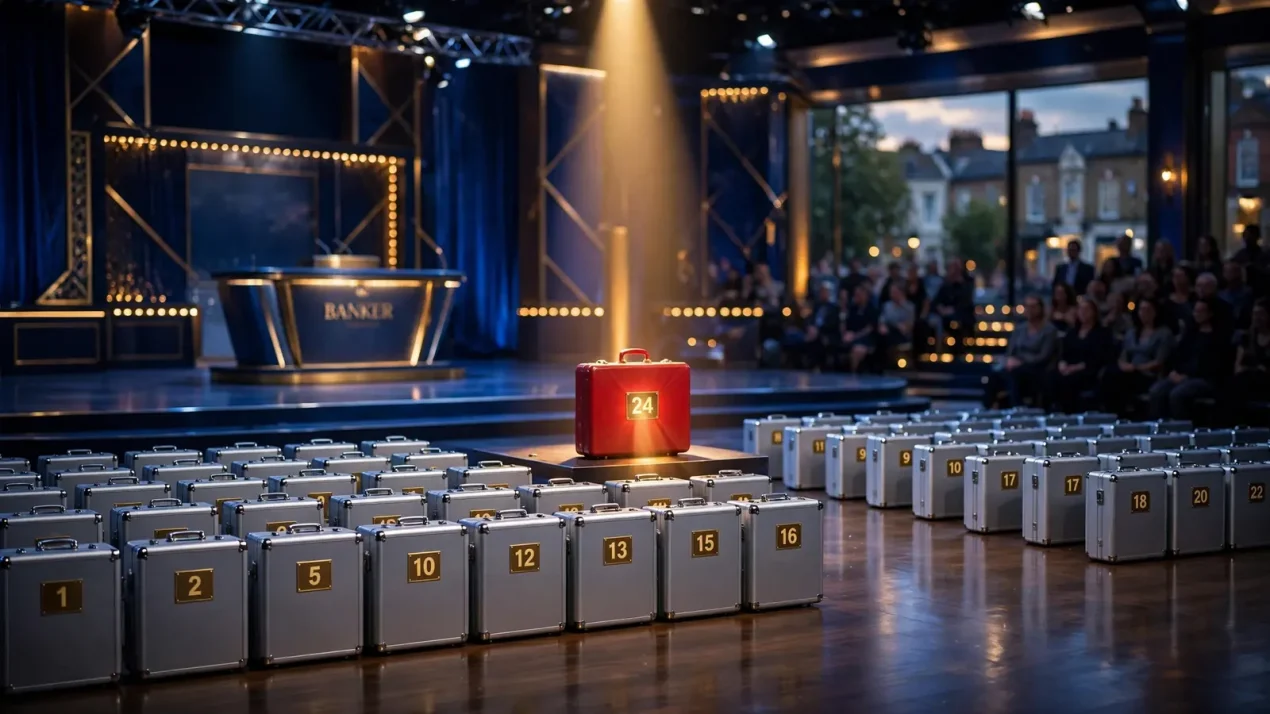
In the television format, play begins with sixteen briefcases. The contestant selects one, and briefcases are opened in stages. The values revealed remove possibilities from consideration, while the value associated with the contestant’s own case remains unknown. After the first three briefcases are opened, the Banker makes an offer. The host then poses the question that gives the show its name: “Deal or No Deal?”
For a Deal or No Deal casino in the UK in 2026, it helps to focus on the details available when weighing your options. These listings include a stated payout-speed estimate for each operator.
1. EvoSpin
Payout speed: 1-3 business days
EvoSpin lists a payout speed of 1–3 business days. This gives you a stated estimate to consider when assessing withdrawals.
2. Britsino
Payout speed: 1-3 business days
Britsino lists a payout speed of 1–3 business days. That is the available detail to use when considering how quickly payouts may be processed.
3. SlotoSport
Payout speed: 1-3 business days
SlotoSport gives a payout-speed estimate of 1–3 business days. It offers a concrete withdrawal timing detail for your consideration.
4. x3bet
Payout speed: 1-3 business days
x3bet lists payouts as taking 1–3 business days. This estimate is the key available detail for assessing its payout timing.
5. Dieselwin
Payout speed: 1-3 business days
Dieselwin states a payout speed of 1–3 business days. Consider this estimate when looking at withdrawal timing.
6. Zombillion
Payout speed: 1-3 business days
Zombillion lists a payout speed of 1–3 business days. This provides a stated timeframe to factor into your assessment.
7. Chanze
Payout speed: 1-3 business days
Chanze gives a payout-speed estimate of 1–3 business days. That is the available factual point to consider for withdrawals.
8. Jetsetspins
Payout speed: 1-3 business days
Jetsetspins lists payouts as taking 1–3 business days. The estimate offers a specific detail about payout timing.
9. BeOnBet
Payout speed: 1-3 business days
BeOnBet states a payout speed of 1–3 business days. Use this as the available indication of its payout timing.
10. SpinFormula
Payout speed: 1-3 business days
SpinFormula lists a payout speed of 1–3 business days. This is the stated detail available for considering withdrawals.
That first choice sets out the basic tension of the format. Accepting an offer means taking the Banker’s proposed amount rather than continuing with the selected briefcase. Rejecting it keeps the contestant in the game, with the value of the chosen case still unresolved. The offer is made against incomplete information: some case values have been revealed, but not the value still held in the contestant’s case. The decision is consequently about whether to settle on a known offer or preserve the possibility of a different outcome.
The sequence continues through further openings and offers. Before the final prediction, the contestant has received three offers from the Banker. The final premise described for the show turns on the last of the sixteen briefcases to be opened: contestants predict whether the amount in that case will be higher than the Banker’s offer. This frames the programme not simply as a succession of reveals, but as a comparison between an offer and an unresolved case value.
The difference between “deal” and “no deal” is thus structural. A deal ends the contestant’s exposure to the uncertain value of the selected briefcase in exchange for the offer. No deal preserves the possibility that the case may be worth more, while also leaving open the possibility that it may be worth less. The briefcase openings provide information, but do not remove the central uncertainty until the relevant value is revealed. The Banker’s role is to make an offer while that uncertainty remains.
Keno Online Casinos in the UK: Games and Payouts
For someone looking for a Deal or No Deal slot in the UK, the title alone does not establish that the online game reproduces every part of the television show. “Deal or No Deal slots” can refer broadly to casino products using the programme’s name or offer-and-choice theme. That wording does not, by itself, specify whether a product uses briefcases, how its rounds proceed, or how its prizes are determined. Those details belong to the rules of the individual game, rather than to the television premise in general.
This distinction matters because the show’s familiar question can appear in different contexts. On television, the question follows a Banker offer and asks the contestant to decide whether to accept or continue. In a casino setting, a game may use a related decision as part of its bonus format, but its qualification steps and other mechanics need to be considered separately. The shared name indicates a connection to the format; it should not be read as evidence that the casino game follows the show’s exact sequence.
The show’s structure can be summarised as a progression from selection, to disclosure, to offers, and finally to a decision involving the remaining uncertainty. The initial openings establish the pattern: three briefcases are revealed, then the Banker offers an amount, and the contestant chooses whether to deal or continue. Subsequent offers maintain that choice as the game develops. The later prediction concerns whether the last briefcase to be opened contains more than the Banker’s offer.
That progression is the relevant reference point when interpreting casino Deal or No Deal titles. It explains why offers, briefcases and a continue-or-accept choice are associated with the name, without assuming that every online version uses the same rules as the programme. A casino Deal or No Deal game should therefore be understood through its own stated mechanics. The television format supplies the premise; it does not, on its own, describe how a particular slot or bonus game operates.
Online casino versions of Deal or No Deal may borrow the television show’s premise and theme, but their specific rules and mechanics are determined by the individual game rather than the TV format.
How the Online Game Qualifies Players and Reaches the Bonus
The online game has an entry stage before the Deal or No Deal bonus begins. A player must first qualify; the stated condition is that all three rings land on a gold slice. Only after that qualification stage can the optional Top Up stage and the main game follow. This sequence matters when assessing a Deal or No Deal slot game online: reaching the bonus is not described as automatic simply because the game has been started.
The qualification condition is specific, but its limits should be kept clear. The requirement concerns three rings and gold slices. It does not, by itself, establish how the rings are presented, what controls are used, or how a result is generated. Those details should not be inferred from the word “slot” or from the game’s familiar title. The reliable point is the outcome required for qualification: every one of the three rings must land on a gold slice.
That makes qualification the gate between the initial play and the bonus sequence. If the condition is met, the game proceeds to the next stage. If it is not met, the described sequence has not yet reached the bonus. The available description does not specify any alternative route into the bonus, so the gold-slice condition is the relevant criterion rather than a general expectation that a bonus will appear during ordinary play.
Aviator Casino Game UK: Licensing and Play
After qualification, Top Up is available as an optional stage. Its stated purpose is to add to prizes before the Deal or No Deal game begins. The order is therefore important: qualification comes first, Top Up may follow, and the main Deal or No Deal game comes after that. Top Up is not the qualification condition itself, nor is it the main bonus game. Treating these as separate steps gives a more accurate picture of the entry sequence than describing the whole feature simply as a single bonus round.
The optional nature of Top Up also distinguishes it from the qualification requirement. All three rings landing on gold slices is necessary to qualify; using Top Up is not described as necessary to enter the Deal or No Deal game. It is a choice within the sequence, with the stated effect of adding to prizes. The description does not establish the amount added, the way any addition is calculated, or any conditions attached to that choice. Those details cannot be inferred from the stage’s name.
For someone looking to play a Deal or No Deal slot machine online, this distinction is useful because the game has more than one point at which a decision or outcome affects progression. First comes the qualification result. Then comes the optional Top Up stage. Then the Deal or No Deal game begins. The sequence does not support treating Top Up as a guaranteed prize increase: it is presented as an option to add to prizes, but no specific value or result is stated.
Bonus Entry Sequence
Step 1: Qualification
All three rings must land on a gold slice to qualify for the bonus.
Step 2: Top Up (Optional)
The player may choose to use the Top Up stage to add to the prizes.
Step 3: Main Game
The Deal or No Deal bonus game begins.
The word “bonus” can also obscure where the main game starts. In this structure, qualifying does not itself mean that the player is already taking part in the Deal or No Deal game. Rather, it permits progression through the Top Up stage, if chosen, and onward to that game. This is a useful distinction for searches for a Deal or No Deal online slot machine or casino game: the title refers to the feature as a whole, while qualification describes the entry condition before its central game begins.
The available description does not provide a basis for claims about how frequently qualification occurs, whether the rings can be influenced, or how long the entry stage takes. Nor does the stated qualification rule establish the value of prizes. Those are separate questions from the sequence itself. The supported account is narrower: three rings must land on gold slices to qualify; Top Up may then be used to add to prizes; and the Deal or No Deal game follows.
This sequence is the starting point for understanding the online version, rather than a description of the television format or of decisions made once the bonus is under way. It identifies what has to happen before the main game becomes available, and separates that requirement from the optional stage that comes after it.
Playing Online in Britain: Game Mechanics and Regulatory Context
Once the bonus game is under way, the central decision is whether to take a Banker’s offer or carry on. Offers arrive as batches of briefcases are opened, creating pauses in which the player may compare the amount offered with the possibility of continuing. The offer is not a separate prize added to the briefcase: accepting it ends that game and the player receives the offered amount. Rejecting it keeps the game in progress.
Monopoly Live Casino UK: Format and Online Play
This structure is what distinguishes a Deal or No Deal online slot from a conventional slot in which a spin resolves directly into a result. The format combines a sequence of revealed prizes with a choice at each offer. Its central tension is not simply whether a symbol combination appears, but whether to exchange the uncertain outcome still in play for the Banker’s stated amount. The decision has an immediate consequence: once an offer is accepted, there is no further continuation in that game.
The term “slot machine” can therefore refer to the casino product through which the feature is accessed, while the bonus round itself follows the show’s offer-and-decision premise. Online casino versions may be described in several ways, including as a Deal or No Deal casino slot or as a Deal or No Deal game online. Those labels do not change the basic mechanic: the Banker makes offers during the bonus, and the player chooses between collecting an offer and continuing. A reference to an online slot should not be taken to mean that every product using the name has identical presentation or rules.
The mechanic also gives the offer a specific role. It is a proposed settlement for the current game, not a forecast of what the remaining play will produce. The offer can be accepted or declined; the player does not negotiate its value. If accepted, the amount becomes the game’s outcome. If declined, the bonus continues, with the possibility of another decision later. No conclusion about which choice is financially preferable follows from the existence of the offer alone. That would depend on the prizes and probabilities involved in the particular game.
Do
- Understand that “Deal” means accepting the Banker’s offer and ending the game.
- Understand that “No Deal” means rejecting the offer to continue playing.
Don’t
- Assume the Banker’s offer is a forecast of the briefcase’s value.
- Assume that accepting an offer allows the game to continue.
For people looking at Deal or No Deal slots online, this distinction matters when interpreting the wording used to describe a product. “Deal” is not merely a theme or a button label: within the bonus, it denotes acceptance of the Banker’s offer and an end to that play. “No Deal” means continuing rather than taking the current offer. The format borrows the familiar decision framework, while the online game applies it to its own bonus sequence.
Online access in Britain also sits within a regulatory system. The UK Gambling Commission oversees gambling activity in the United Kingdom, including online casino gambling. In Great Britain, it is the sole regulator of commercial gambling. Its remit for remote gambling offered to consumers in Great Britain does not depend on where an operator’s key equipment is located. A business cannot avoid the relevant British regulatory framework simply by placing its systems elsewhere.
The Commission issues operating licences to gambling businesses and personal licences to individuals working in regulated roles. These are distinct permissions: an operating licence concerns the business offering gambling, while personal licensing applies to individuals whose roles fall within the licensing system. The wider legal framework is not identical across every part of the UK. The Gambling Act 2005 applies in England, Wales and Scotland; Northern Ireland is outside that Act’s scope.
For a casino game offered for real money to consumers in Great Britain, the operator’s licensing status is therefore relevant independently of the game’s branding. A Deal or No Deal casino online is not exempt from the rules governing remote gambling because it is presented as a familiar television format or because its bonus resembles a studio game. Regulation attaches to the gambling activity and the operator, rather than to the popularity or presentation of a particular title.
Live Baccarat Online Casinos in the UK: How It Works
The distinction between a game and the site offering it is useful. The game’s Banker mechanic determines what happens after an offer is made; regulation concerns the business providing access to gambling and the requirements that apply to it. The UK Gambling Commission’s oversight of remote gambling in Great Britain is not limited to operators whose equipment is physically based there. Thus, the location of a server does not by itself determine whether British regulatory obligations apply.
A search for a Deal or No Deal slot machine, online casino game or similar product may bring together different kinds of offerings under one familiar name. The common feature established by the game’s described bonus mechanic is the choice to accept a Banker’s offer or continue. For British online play, however, the relevant regulatory question is separate: whether the operator providing the game is authorised under the applicable system. The format explains the player’s in-game decision; the licensing framework governs the provision of remote gambling.
Free Play and Demo Versions: What the Available Evidence Shows
A demo or free-play version is distinct from a real-money game: it refers to access without staking cash, while the game’s mechanics may otherwise appear similar. The label alone does not establish how a particular version works, whether it is available, or whether its play conditions match those of a real-money version. Those distinctions matter when interpreting claims about Deal or No Deal slot demo play or free play.
A specialist review reports that the game help files state an expected return of 95.42%. This is a figure attributed to those help files, not a general return rate for Deal or No Deal games, casino games, or demo versions. It should not be read as a promise about the outcome of an individual game. Nor does the figure say whether the version described is available to play without a deposit or stake.
Fastest Payout Online Casino UK: What It Means
The expected return and access format answer different questions. The return figure concerns the game’s stated payout expectation; a demo label concerns the terms on which someone can access a game. One cannot establish the other. In particular, a stated return does not show that free online play is offered, that a demo uses the same configuration as the real-money game, or that either version is accessible through a given casino.
This distinction also applies to searches for a free Deal or No Deal slot game. A page may describe a game without establishing that it can be played in demo mode. Likewise, a game’s appearance or title is not enough to identify its access conditions. The help-file figure is relevant only as a reported specification of the game; it does not provide a description of a free-play mode.
The same caution applies to the Megaways name. The wording “Deal or No Deal Megaways” may refer to a specific variant, but the return figure attributed to the game help files does not establish that such a variant exists, that it has a demo, or that the reported return belongs to it. A shared title or theme cannot, by itself, show that two games have the same features or return.
For a useful comparison, the version and its stated terms need to be identified separately from any return figure. A demo, where offered, should not be assumed to reproduce every feature or condition of a cash game. Conversely, a return specification associated with a cash game should not be transferred to free play without evidence that it applies to that version. The available figure provides no basis for making that transfer.
Casino Dice Games in the UK: Rules and Randomness
Consequently, the reported 95.42% should be treated narrowly: it is an expected-return figure that a specialist review attributes to the game help files. It does not confirm a free or demo version, establish the conditions under which one can be played, or verify a Megaways edition. Keeping those questions separate avoids treating a technical game specification as proof of access.
Bonus Offers and Named Slot Variants: What Can Be Confirmed
Interest in a no-deposit bonus alongside Deal or No Deal, or in named versions such as Golden Box Megaways and Double Action, raises two separate issues: what the game itself requires and what a casino promotion may offer. These should not be treated as the same feature. A bonus label does not describe the game’s entry sequence, and a game title alone does not establish the terms of a promotion.
The confirmed structure begins with qualification. All three rings must land on a gold slice for a player to qualify. Top Up is then optional: it can be used to add to prizes before the Deal or No Deal game begins. This sequence matters when assessing claims about a particular version. Qualification and Top Up describe stages in the game process; they do not establish that a no-deposit bonus is available, or that a named slot variant uses different rules.
Attention: A no-deposit bonus is a casino promotion and is entirely separate from the game’s internal Top Up stage or qualification mechanics.
The same distinction applies to Double Action. They do not confirm that Double Action is a separate game, identify a provider, or substantiate variant-specific features. The title should therefore not be used as evidence that the game has an additional mode or a particular bonus structure.
Golden Box Megaways likewise should not be conflated with the confirmed Deal or No Deal game sequence. A branded title may suggest a relationship, but a title by itself cannot establish how a game plays or whether its mechanics match those described above. The confirmed entry process remains limited to qualifying through the ring result, followed by the optional Top Up stage and then the game.
Promotional claims require separate scrutiny from game mechanics. A no-deposit offer, if presented by an operator, is a promotion rather than a qualification condition shown by the game structure. Its availability and terms cannot be inferred from the presence of Deal or No Deal branding or from the Top Up option. Nor does Top Up mean that a casino bonus has been added: it is an optional stage within the game sequence, while a casino promotion is a separate offer.
For a comparison, the useful distinction is between what is shown as part of the game and what an operator advertises as a promotion. The confirmed mechanics are specific: qualification depends on all three rings landing on gold slices, Top Up may be used to add to prizes, and the Deal or No Deal game follows. Claims about a no-deposit promotion or named variants need to be assessed on their own terms, rather than assumed from that sequence.
Free Spins and Box Clever Searches: Evidence and Limitations
Free spins and the Deal or No Deal bonus game describe different kinds of play. A free-spin offer concerns how spins are provided in a slot; the established bonus mechanic is defined by Banker offers and a choice to accept or continue. The presence of one does not establish the availability of the other.
During the bonus game, briefcases are opened in batches. After each batch, the Banker makes an offer. The player can take that offer or reject it and carry on. This accept-or-continue choice is the central mechanic relevant to searches for free spins: it describes a decision within the bonus game, not a free-spin award.
Live Blackjack Casinos in the UK: How to Compare
The distinction matters because the phrase “free spins” can suggest a promotional feature, while the bonus game has its own sequence and choices. Neither the Banker’s offer nor the option to continue should be described as free spins. Equally, a search for free spins does not establish that a promotion is attached to the game, or what its terms might be.
“Box Clever” should also be kept separate from the mechanics described here. The name alone does not change how the Banker offers work, and it should not be treated as evidence that a particular Box Clever version shares the same rules or features. A title and a bonus-game mechanic are not interchangeable descriptions.
For an accurate account of the Deal or No Deal bonus, the reliable point is narrow: offers follow batches of opened briefcases, and play can end when an offer is accepted or continue when it is declined. Free spins and Box Clever should not be inferred from that mechanic. This avoids treating promotional language or a named title as proof of a feature that the offer-and-continue rules do not describe.
What Is in Your Box? The Remaining-Briefcase Decision
At the end of the game, the decision shifts from responding to the Banker’s offers to choosing between the two briefcases still unopened. The player can keep the briefcase already held or switch to the other one before either is opened. The contents remain concealed at the point of choice, so the decision concerns which unopened case to retain, not a revealed prize.
This moment follows four Banker offers. The option to switch is therefore distinct from accepting an offer: it changes which briefcase is selected, rather than taking the Banker’s proposed amount. The choice is made before the final cases are opened, when neither remaining prize has yet been disclosed.
The phrase “What’s in Your Box?” captures the uncertainty at the centre of this stage, but it does not identify the contents in advance. A switch may lead to a different prize from keeping the original case; the available mechanics do not establish that either choice is more likely to produce a better result. Nor do they provide a basis for treating the remaining cases as having equal or unequal chances.
French Roulette Online Casinos in the UK: Rules & Odds
Searches that combine this game name with RTP require a separate distinction. A specialist review reports that the game help files state an expected return of 95.42%. That figure describes expected return across play as reported by that source; it does not reveal the value in either remaining briefcase or indicate whether switching is preferable in a particular round. It should not be read as a prediction of an individual result.
Accordingly, the end-stage choice is best described in procedural terms: retain the current briefcase or switch to the other unopened one, then discover the outcome when the cases are opened. The mechanics confirm the availability of both options, but do not establish a strategy that guarantees a better prize.
Reviewing Double Action and What’s in Your Box: A Limited Evidence Base
A review of Deal or No Deal: Double Action or What’s in Your Box needs to distinguish a named title from the mechanics that can be established for the game format. The names alone do not confirm a particular set of features, prize structure or rules. A review that attributes such details to either variant without clear supporting information would go beyond what can be stated with confidence.
The documented mechanic is that the Banker makes offers as suitcases are opened. The player may accept an offer or continue, and switching suitcases becomes an option after the fourth offer. This describes the general offer-and-continue structure; it does not, by itself, establish that either named title uses a distinct version of it. Nor does it support conclusions about whether one variant is more generous, more strategic or more engaging than the other.
That distinction matters when assessing claims attached to the phrase “Double Action”. The wording may suggest an additional feature, but the name is not evidence of what that feature entails. Similarly, “What’s in Your Box” signals a connection to the briefcase premise, but does not establish how its rules compare with another release. A sound comparison would require title-specific information, rather than an inference drawn from the names.
The ability to switch briefcases is available only after the fourth Banker offer has been made.
The general mechanic can still inform a limited assessment: Banker offers create a decision point during play, while the ability to switch after the fourth offer adds another choice. Those features describe the structure, not its likely financial outcome. No conclusion about the expected value of accepting or continuing follows from the offer sequence alone.
Accordingly, these titles can be discussed in relation to the familiar Deal or No Deal format, but a detailed review of their individual rules cannot be made on that basis alone. Claims about variant-specific features should be treated separately from the established suitcase-and-offer mechanic. This keeps an assessment precise without turning suggestive names into unsupported descriptions.
Perfect Play and the Final Deal-or-Switch Choice
“Perfect play” suggests that one final decision can be identified as correct. In Deal or No Deal, however, the final stage presents different outcomes rather than a single choice that is automatically best: accept the Banker’s offer, reject it and take the prize in the player’s briefcase, or switch to the last unopened briefcase.
Accepting ends the game with the offered amount. Rejecting leaves the briefcase prize as the outcome. Switching replaces that potential prize with the one in the other unopened briefcase. The choice therefore turns on which outcome is preferred, not on a guaranteed method for improving it. A decision to switch cannot be described as better merely because it changes the briefcase; nor does keeping the original briefcase ensure it contains the larger prize.
The final offer also needs to be considered separately from the two briefcase outcomes. It provides a definite alternative to continuing, while rejecting it leaves the player with a choice between the remaining cases. Those options are structurally distinct, but the game’s available mechanics do not establish that one is universally optimal. Calling a particular action “perfect” without defining the objective—such as preferring the offer or pursuing a briefcase prize—would therefore overstate what the rules can show.
For a slot-style version, the phrase “perfect play” can be understood as a request for a reliable decision rule. The final choice alone does not provide one. It identifies the possible outcomes, but it does not make the Banker’s offer, the held briefcase prize and the other case equivalent or predict which will be most favourable. The defensible description is narrower: the player can take the offer, keep the current case, or switch, with each action determining a different route to the game’s outcome.
Free Online Play: What the Return Figure Does—and Does Not—Tell Us
A specialist review reports that the game’s help files state an expected return of 95.42%. This is a theoretical measure associated with the game, not a prediction of what an individual session will return. It does not indicate that a particular player will receive that proportion of their stake, nor does it describe the outcome of a single play.
The figure also answers a different question from whether the game can be played without paying. An expected-return percentage provides no information about the access mode: it does not show whether a free version is available, how such access would work, or whether its terms would match those of paid play. The percentage should therefore not be treated as evidence that free online play is offered.
For anyone comparing the game’s stated return with its availability, these are separate properties. The return figure concerns the game’s expected results over time; free access concerns the conditions under which the game can be played. Neither can be inferred from the other. Nor does the stated percentage, on its own, establish how frequently particular prizes occur or how results are distributed.
The reported figure is specific to the help-file information described in that specialist review. It should not be generalised to all Deal or No Deal-branded games, or assumed to apply to every version presented online. A return percentage is useful only when its scope is clear; without that context, it cannot settle questions about access or predict an individual outcome.
This material was created by the Ninewin UK Guide team.
Related posts

UK Crypto Casinos With No KYC: Rules and Limits

TRON (TRX) Casino Comparison for the UK
